HERBAL & NATURAL HEALTH SUPPLEMENTS!!!

Piles, Fissure & Fistula Treatment


BLIDOPYL - Herbal Capsules for Piles, Fissure & Fistula Treatment
₹ 1,150
BLIDOPYL is highly effective in treating Internal/ External Piles, Fissure and Fistula.

Bottle Content: 60 Capsules
Direction of Use: 1 capsule before breakfast and 1 capsule after dinner
Features & Benefits:
- Wound Healing Activity
- Anti-inflammatory and Anti-bacterial Activity
- Stimulating Effect on the Endometrium
- Mild Laxative
- Purgative
Ingredients:
1. Lajalu

Botanical Name: Berberies Pudica
Active Constituents: It contains alkaloids, amino acid, flavonoids, glycosides, sterols, terpenoids, tannins and fatty acids in it.
Mechanism: Lajalu helps manage Piles due to its Pitta and Kapha balancing properties. It also reduces burning sensation and discomfort due to its Sita (cool) nature and Kashaya (astringent) property. The plant contains haemostatic property which helps in controlling bleeding in piles. It can also be applied externally to fissures, skin wounds, and ulcers. The phytoconstituents present in lajalu possess antioxidant, anti-inflammatory, and antimicrobial properties the help increases the rate of wound contraction and closing. It also helps in collagen formation and regeneration of new skin cells. It also reduces the risk of infection in the wound, thereby promoting wound healing Lajalu helps in wound healing due to its Sita (cool) and Ropan (healing) properties. It helps reduce the pain and inflammation while also promoting healing of wounds.
Reference: The Ayurvedic Pharmacopoeia of India. Part 1 Volume 1.
Joseph B, George J, Mohan Pharmacology and Traditional Uses of Mimosa pudica.International Journal of Pharmaceutical Sciences and Drug Research 2013; 5(2): 41-44.
Singh MP, Bhargava S, Bhaduaria RS, et al. Wound healing potential of alcoholic extract of Mimosa pudica Linn. leaves.Pharmacologyonline.2010; 2:32-38
2. Daruhaldi

Botanical Name: Berberis Aristemsata
Active Constituents: The plant includes several significant phytochemicals including proto-berberine, isoquinoline, bisbenzyl-isoquinoline, and other bioactive constituents like flavonoids and phenolic acids.
Mechanism: Daruhadi has the ability to treat bleeding pipes. These benefits of alcoholism are due to its antioxidant, antibacterial, antifungal and antiviral properties. All these properties are helpful in reducing the symptoms of hemorrhoids and protecting the body from other types of infections.
Reference: Daruharidra (Berberis aristata): Review based upon its Ayurvedic Properties
Shailja Choudhary1 , Hemlata Kaurav2 , Madhusudan S. 3 and Gitika Chaudhary4 1
Research and Development Department, Shuddhi Ayurveda, Jeena Sikho Lifecare Pvt. Ltd., Zirakpur 140603, Punjab, INDIA.
3. Ashoka

Botanical Name: Sarasa Ashoka
Active Constituents: Major constituents in the stem bark of Asoka are tannins (0.57%–7.85%), ash (2.43%–6.69%), and other extracts (5.74%–14.07%).
Mechanism: Ashoka gives relief in swelling of pile mass by balancing Vata. Ashoka also reduces burning sensation and discomfort in piles due to its Sita (cold) nature. It gives cooling effects and reduces burning sensations in the anus. According to Ayurveda, Ashoka is useful in controlling internal bleeding, especially in the case of piles due to its Kasaya (astringent) property. It is also beneficial in relieving pain and healing wounds faster due to its Ropan (healing) property.
Reference:
- The Ayurvedic Pharmacopoeia of India.Part 1 Volume 1.
- Borokar AA, Pansare TA.Plant profile, phytochemistry and pharmacology of Ashoka (Saraca Asoca (Roxb.), De. Wilde) – A Comprehensive Review. JAHM.2017; 7(2):2524–2541.
4. Behada

Botanical Name: Terminlia bellirica
Active Constituents: Glycosides, tannins, galliacid, ellagic acid, ethyl gallate, gallylglucose, chebulanic acid are believed to be mainly responsible for its wide therapeutic actions.
Mechanism: Behada helps to manage loss of appetite, thirst, bloating and flatulence. This is due to its Ushna (hot) potency. Behada enhances the Pachak Agni (digestive fire) which helps in digesting the food easily. It also helps to manage constipation due to its Rechana (laxative) nature. It gives soothing and lubricating effect on the gastro enteric tract and helps in easy expulsion of stool. Behada may be useful in promoting wound healing. It contains certain components that reduce the size of the wound and increase the rate of wound closure
Reference:
Motamarri SN, Karthikeyan M, Kannan M.Terminalia belerica .Roxb-A phytopharmacological Review. International Journal of Research in Pharmaceutical and Biomedical Sciences.2012;3(1):96-99.
6. Hirda
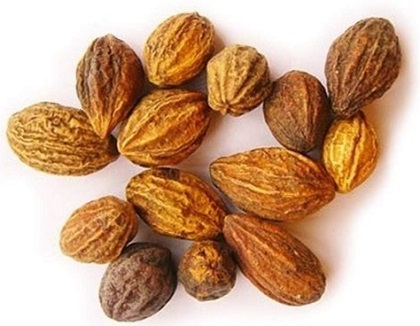
Botanical Name: Terminalia chebula
Active Constituents: A number of glycosides have been isolated from haritaki, including the triterpenes arjunglucoside I, arjungenin, and the chebulosides I and II. Other constituents include a coumarin conjugated with Gallic acids called chebulin.
Mechanism: Terminalia chebula has laxative and purgative properties while Jaggery activates the digestive enzymes in the body. This herbal combination is helpful in curing piles in a magic way. The laxative and tonic properties of Haritaki help in constipation and haemorrhoids as a natural laxative and purgative, it removes undigested food and accumulated toxins from the gastrointestinal tract. It promotes appetite and helps in proper digestion. It increases the frequency of stools and has got the property of evacuating the bowel completely. It stimulates the liver and protects it further by expelling the excretory waste products from the intestine.
Reference:
Role of Terminalia chebula on Gastrointestinal Mucosa
Rakhi Mehra*, Renu Makhija, Neera Vyas
ACRI, CCRAS, Dept. of AYUSH, Ministry of Health and Family Welfare, Govt. of India.
How BLIDOPYL Works?
- Tannic acid and chebulinic acid in Terminalia Chibula Roxb and Terminalia Belirica Roxb shows wound healing activity. Mimosin and phenolic compounds shows dramatic wound healing activity from Mimosa pudica.
- Bleeding in internal and external hemorrhoids cover by Wound healing activity of Teminalia Chibula. (Chebulagic acid, Chebulinic acid ,Tannic Acid ). Thrombosis of vessels. Shrinkage of mucosa.
- Pains in internal , external hemorrhoids reduce by Analgesic Activity of Terminalisa Bellirica and Berberis Species. (Chebulagic acid, Chebulinic acid ,Tannic Acid , Berberin).Act directly on pain receptor and control secretion of Prostaglandin. Prostaglandin is neurotransmitter carry towards receptors.
- Inflammation in internal and external hemorrhoids reduce by anti-inflammatory activity of Berberis Species. (Berberin). Inflammatory response can majorly cover due to berberin. Berberin play major role in fistula and fissure by acting on Gram +ve and Gram –ve Bacteria in internal tubing. Main important action is discharge of pus to clean tubes in fistula and fissure modules.
- Constipation Recover by improving ciliary action of Teminalia. Also helps to improve metabolism and digestion due to tannic acid. It also helps to improve section of digestive enzymes.
- Rubia Cardifolia is used as blood purifier. (Mollugin). Rubia Cardifolia help to remove toxins in body which are responsible for all anal disorders.
- Synergistic action of all above ingredients is low down pressure on varicose vein as well as small blood capillaries. Swollen blood vessels leads to internal and external hemorrhoids.
- BLIDOPYL acts as thrombosis of small blood vessels by acting on factor VII leads to shrinkage and helps to stop unwanted bleeding.
Difference between Piles, Fissure & Fistula:

Basic Information about Piles:
- Piles are collections of tissue as well as vein that become inflamed and swollen.
- The size of piles can vary they are found inside or outside the anus call as Internal and external Hemorrhoids.
- Piles occur due to chronic constipation, heavy weights, chronic diarrhea, straining when passing a stool, lifting pregnancy, Nicotine and Alcohol consumption, Hereditary. They may develop due to changes in the hormones (chemicals) in your body and the increased pressure in your abdomen (tummy), although doctors aren’t sure. etc.
- Hemorrhoids are graded on a scale from I to IV. At grades III or IV.
Types of Piles - Internal & External Piles:

Four Stages of Piles:

Piles are usually small, round, discoloured lumps. Piles can develop when this tissue becomes swollen, possibly as a result of straining on the toilet. Sometimes, piles can be painful and bleed if they become damaged.
Stage I: May bleed but doesn’t come out of your anus. Constipation and itching and normal pain.
Stage II: Comes out of your anus when you have a bowel movement, but go back inside on their own afterwards. Normal bleeding and pains during bowel movement.
Stage III: Comes out of your anus and only go back inside when you push them in. Sevier pain all time and bleeding at bowel movements.
Stage IV: Partly outside your anus and you can’t push them back in. They may become very swollen and painful if the blood inside them clots. Sevier pain and usual bleeding.
Symptoms of Piles:
- Bleeding during bowel movement
- Lumps found around anal area
- Slimy discharge of form affected area
- Feeling that your bowels haven’t emptied completely
- Itchy or sore skin around your anus pain and discomfort after a bowel movement
Diagnosis of Piles:
Your GP will ask about your symptoms and examine you. He or she will feel your rectum by gently inserting a gloved finger into your anus. Your GP may also use a proctoscope to look inside your rectum. A proctoscope is a short, narrow, tube-like instrument. There are a few different types of proctoscope – some of them have their own light source whereas others don’t. You might find the procedure uncomfortable.
Your GP may also ask you to have a blood test to check if you have anaemia. This is a low number of red blood cells in your blood. Anaemia can be a sign that you have a more serious condition.
If your test results suggest your symptoms might be caused by something else, your GP may refer you to hospital for more tests. These can rule out other conditions, such as cancer.
Complications in Piles:
Piles are very common & rarely cause any serious problems but may lead to some complications, such as:
- Formation of ulcers on external piles
- Mucus discharge from anus can cause the surrounding skin to get very sore and damaged.
- Severe piles (fourth degree) can sometimes get strangulated, means they lose their blood supply & becomes very painful and causes the tissue to die.
- Gangrene may develop from stage-IV internal Piles which can be life-threatening also.
- Perianal abscess/sepsis may occur. As the blood vessels are directly connected to the liver, any infection in anal region can easily spread All over the body and cause serious complications like portal pyemia, septicemia, coma & death.
- Untreated Piles or repeated piles surgery in long term can lead to very rare rectal cancer.
- Piles can make you feel self-conscious (about having sex for example). If you need any advice, contact your Doctor.
Prevention in Piles:
The following lifestyle measures can help to keep your faeces soft, preventing constipation and piles.
- Eat plenty of fibre-rich foods such as fruit, vegetables, wholegrain cereal, wholegrain rice and pasta, nuts, beans and pulses. Aim to eat 30 gm of fibre a day. As a guide, half a cup of bran cereal contains nearly 15g of fibre and a medium-sized apple has about 4 gm.
- Drink plenty of fluids. Try to limit your intake of caffeinated drinks.
- Avoid caffeinated drinks & Alcohol.
- Avoid sitting for long time in same place.
Basic Information about Fissure:

An anal fissure is a cut or tear occurring in the anus (the opening through which stool passes out of the body) that extends upwards into the anal canal. Anal fissures occur in the specialized tissue that lines the anus and anal canal, called anoderm. At a line just inside the anus skin. Unlike skin, anoderm has no hairs, sweat glands, or sebaceous (oil) glands and contains a larger number of sensory nerves that sense light touch and pain.
Causes of Anal Fissures:
Anal fissures are caused by trauma to the anus and anal canal. The fissure may be caused by a hard stool or repeated episodes of diarrhea. Occasionally, the insertion of a rectal thermometer, enema can result in sufficient trauma to produce a fissure. The most common location for an anal fissure in both men and women (90% of all fissures) is the midline posteriorly in the anal canal, the part of the anus nearest the spine. 10% of fissures in women are anterior, while only 1% are anterior in men. At the lower end of fissures a tag of skin may form, called a sentinel pile.
Symptoms of Anal Fissures:
People with anal fissures almost always experience anal pain that worsens with bowel movements. The pain can be so severe that patients are unwilling to have a bowel movement, resulting in constipation and even fecal impaction. Moreover, constipation can result in the passage of a larger, harder stool that causes further trauma and makes the fissure worse. Bleeding in small amounts, itching (pruritus ani), and a malodorous discharge may occur due to the discharge of pus from the fissure.
Basic Information about Fistula:

Fistula can occur between the intestines and the skin in the breech region is called anal fistula or fairy anal fistula. Later, he opens an exit hole around the breech and starts to flow out of that area. The activity of inflammation is called the external mouth of the fistula in this hole. The inner mouth opens to the intestine where we call the dentate line. Anal fistulae originate from the anal glands located between the internal and external anal sphincter then drain into the anal canal. Abscess form due to blockage of outlet. The tract formed by this process is a fistula. Among the descriptions of the perianal fistula, the inflammatory flow from the outlet point, which we call the outer mouth, takes the first order. Anal fistulae per se do not generally harm, but can be very painful, and can be irritating because of the drainage of pus.
Types of Anal Fistula:
- Extrasphincteric Fistulae: These begin at the rectum or sigmoid colon and proceed downward, through the levator ani muscle and open into the skin surrounding the anus. Note that this type does not arise from the dentate line .
- Suprasphincteric fistulae: These begin between the internal and external sphincter muscles, extend above and cross the puborectalis muscle, proceed downward between the puborectalis and levator ani muscles, and open an inch or more away from the anus.
- Transphincteric fistulae: These begin between the internal and external sphincter muscles or behind the anus, cross the external sphincter muscle and open an inch or more away from the anus.
- Intersphincteric fistulae: These begin between the internal and external sphincter muscles, pass through the internal sphincter muscle, and open very close to the anus.
- Submucosal fistulae: They pass superficially beneath the submucosa and do not cross either sphincter muscle.
Signs & Symptoms of Anal Fistula:
Pus, serous fluid and/or (rarely) feces discharge. Depending on presence and severity of infection: Pain, Swelling, Tenderness, Fever, Unpleasant odor