

ECOLAX Capsules
₹1,150
USES:
- Laxative – Laxatives are a type of medicine that can treat constipation. They’re often used if lifestyle changes
- Improve Digestion – They speed the movement of the digestive system to induce a bowel movement.
- Free Bowel Movement – These stimulate the digestive tract walls, speeding up bowel movement.
- Detoxify Small and Large Intestine – Laxative work by helping the body to draw out liquids from the intestinal walls, making the fecal matter softer and easier to pass.
- Relief from gas, acidity and bloating – This medicine contains such ingredient like behada which is used to treat the symptoms of too much stomach acid, gases and bloating.
- Helpful in all kind of Piles – This capsule is a laxative and it has beneficial effect in the treatment of symptomatic hemorrhoids.
ADVANTAGES:
- Effective relief from constipation.
- Healthy digestive system.
- Free from Preservative.
- Acts as a Natural Laxative.
- It gives rapid relief.
INGREDIENTS:
| Sr No | Ingredients | Permitted Range |
| 1 | Terminalia Chebula Extract | 0.5 gm |
| 2 | Phyllanthus emblica L. Extract | 1 gm |
| 3 | Terminalia belerica (Gaertn.) Roxb. Extract | 0.5 gm |
| 4 | Ocimum sanctum L. Extract | 0.25 gm |
| 5 | Rubia cordifolia Stem | 1 gm |
| 6 | Berberis aristata DC. Stem extract | 0.5 gm |
| 7 | Plantago ovata Forssk. Husk | 5 gm |
1. Hirda
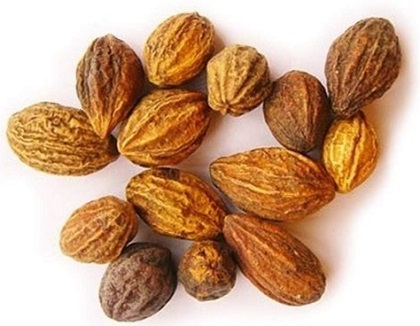
Botanical Name: Terminalia chebula
Active Constituents: A number of glycosides have been isolated from haritaki including the triterpenes, arjunglucoside I, arjungenin, and the chebulosides I and II. Other constituents include a coumarin conjugated with Gallic acids called chebulin
Mechanism: Terminalia chebula has laxative and purgative properties while Jaggery activates the digestive enzymes in the body. This herbal combination is helpful in curing piles in a magic way.
2. Behada

Botanical Name: Terminlia bellirica
Active Constituents: Glycosides, tannins, galliacid, ellagic acid, ethyl gallate, gallylglucose, chebulanic acid are believed to be mainly responsible for its wide therapeutic actions.
Mechanism: Behada helps to manage loss of appetite, thirst, bloating and flatulence. This is due to its Ushna (hot) potency. Behada enhances the Pachak Agni (digestive fire) which helps in digesting the food easily
3. Amla

Botanical Name: Phyllanthus emblica
Active Constituents: The fruit of Amla is rich in vitamin C (ascorbic acid) and contains several bioactive phytochemicals, of which majority are of polyphenols (ellagic acid, chebulinic acid, gallic acid, chebulagic acid, apeigenin, quercetin, corilagin, leutolin, etc.)
Mechanism: Amla helps to reduce gastrointestinal problems by improving the Pachak Agni (digestion fire). It also helps in easy expulsion of stool due to its Rechana (mild laxative) property.
4. Tulsi

Botanical Name: Ocimum sanctum
Active Constituents: Eugenol (1-hydroxy-2-methoxy-4-allylbenzene), the active constituent present in Ocimum sanctum L., has been found to be largely responsible for the therapeutic potentials of Tulsi.
Mechanism: Many of the physiological benefits of tulsi can be attributed to its ability to assist with the body’s internal housekeeping and protection of the body from toxin-induced damage. These functions are often attributed to tulsi’s high content of phenolic compounds and anti-oxidant properties.
5. Manjistha

Botanical Name: Rubia cordifolia
Active Constituents: The various chemical constituents present in Manjistha are quinones, iridoids, oleananes triterpenoid, bicyclic hexapeptides and anthraquinones. Some notable anthraquinones are alizarin, purpurin, and rubicordifolin.
Mechanism: In ayurvedic medicine, Manjistha is a blood purifying herb. It cools and detoxifies the blood, removes stagnant blood, and dissolves obstructions in the blood flow. Manjistha also helps protect gums from receding.
6. Daruhaldi
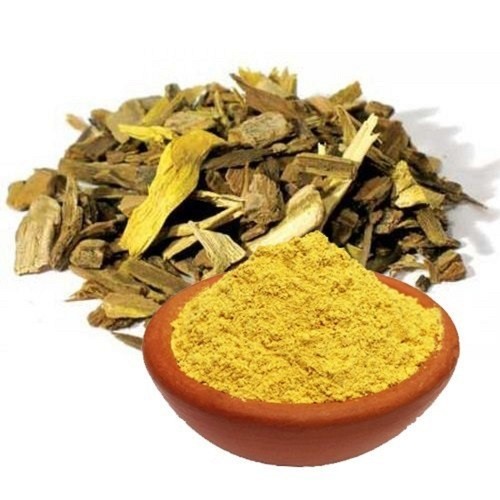
Botanical Name: Berberis aristata
Active Constituents: Phytochemical analysis of various species of this genus revealed the presence of alkaloids, tannins, phenolic compounds, sterols and triterpenes.
Mechanism: The plant is useful as anti-pyretic, anti-bacterial, anti-microbial, anti-hepatotoxic, anti-hyperglycaemic, anti-cancer, anti-oxidant and anti-lipidemic agent. B.
7. Psyllum

Botanical Name- Plantago ovata Forssk
Active Constituents: It is rich in fibre and mucilage. Mucilage is a colourless gelling agent capable of expanding in volume as it absorbs water up to 40 times its weight.
Mechanism: Psyllium husk or more commonly known as Isabgol acts as a wetting agent that increases the stomach’s bulk density to help increase the stool.